


No paid pastors in the Bible!
(To clarify, I have nothing against Pastors, as long as we do things Biblically and not do it according to the system of this world)
1. There were no salaried “professional pastors” in the early church.
In the New Testament, we do not see:
Fixed monthly salaries.
Employment contracts.
A clergy–laity system.
One man paid to “run” a church.
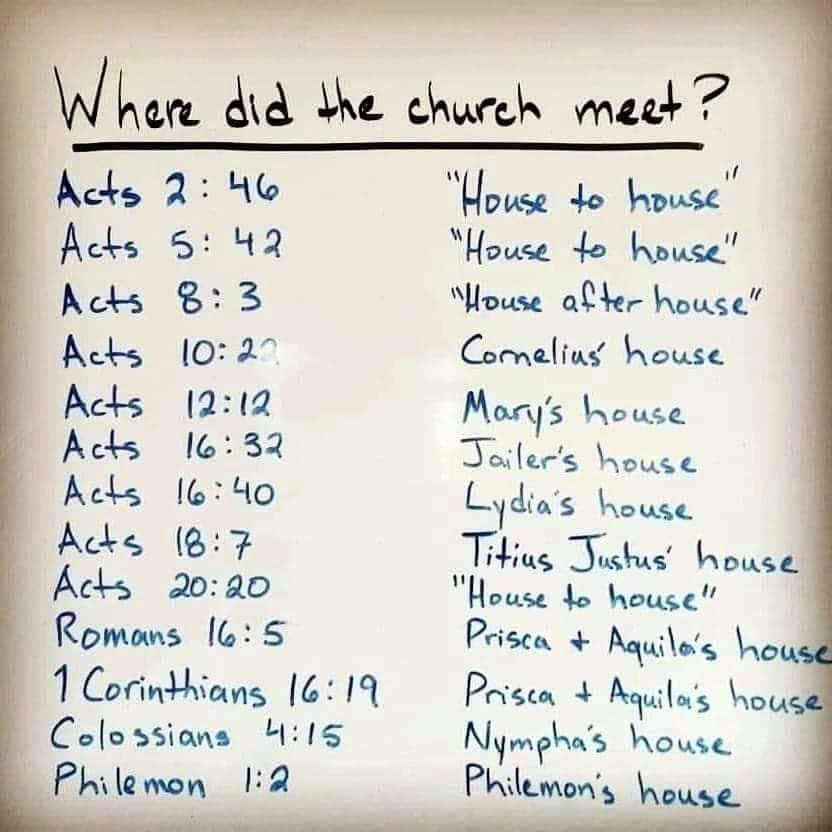
Local gatherings met in homes (Romans 16:5), leadership was plural (elders, not one CEO pastor), and ministry was shared among the body (1 Corinthians 14:26).

Ephesians 4:11–12 Leaders were given to equip the saints, not replace them.
2. Leaders were often self-supporting.
Paul is the clearest example.
Paul refused payment at times to avoid hindering the Gospel.
He worked as a tentmaker (Acts 18:3).
Acts 20:33–35“I coveted no one’s silver or gold… these hands provided for my necessities.”
1 Thessalonians 2:9“We worked night and day, so that we would not be a burden to any of you.”
This shows that full-time paid ministry was not the norm.
3. Yet the Bible DOES allow support — not salaries.
This is where many get confused.
1 Corinthians 9:14“Those who preach the gospel should live from the gospel.”
1 Timothy 5:17–18Elders who rule well are worthy of double honor — which includes financial support, not wages.
Key distinction:
✅ Support — voluntary, need-based, love-driven.
❌ Salaries — contractual, guaranteed income, employer–employee model.
Paul had the right to receive support, but often laid it down for the sake of grace.
4. Jesus warned strongly against ministry for money.
Matthew 10:8“Freely you have received; freely give.”
John 10:12–13A hired hand runs when trouble comes.
1 Peter 5:2Shepherd the flock of God not for shameful gain.
When money becomes the motive, shepherds become hirelings.
5. Tithing was NEVER commanded to the church.
Tithing was part of the Mosaic Law, tied to the Levitical priesthood (Numbers 18).
The church is not under that system (Hebrews 7).
New Testament giving is:
Voluntary.
Spirit-led.
According to ability.
For needs, not institutions.
2 Corinthians 9:7“Not reluctantly or under compulsion.”
6. What we see today is a post-biblical system.
The paid-pastor model developed:
After Constantine (4th century).
When churches became institutions.
When hierarchy replaced family.
This system often:
Silences the body.
Creates dependency.
Turns calling into a career.
7. Biblical summary.
Biblical Pattern. | Modern System. |
Shared leadership. | One paid pastor. |
Voluntary support. | Guaranteed salary. |
Home gatherings. | Buildings & budgets. |
Saints do ministry. | The pastor does ministry. |
Grace-led giving. | Tithing pressure. |

The Bible supports:✔ Supporting those who serve.❌ Employing pastors as religious professionals.
No PAID Pastors:
All who preached were employed in some sort of skills:
Doctors.
Carpenters.
Tentmakers.
Tax Collectors.
The early church thrived without paid pastors, because Christ was the Head, not payroll.
Matthew 23:8“You are all brothers… and one is your Teacher, the Christ.”
God deliberately chose working men, not religious professionals.
This is not random. Scripture is revealing a kingdom pattern.
Jesus — a carpenter (τέκτων)
Mark 6:3“Is this not the carpenter?”
Jesus worked with His hands for ~30 years.
He did not live off offerings.
He did not establish a ministry payroll.
The Son of God chose labor, not leverage.
Paul — a tentmaker.
Acts 18:3“Because he was of the same trade, he stayed with them and worked; for they were tentmakers.”
1 Corinthians 4:12“We labor, working with our own hands.”
Paul explicitly contrasts himself with those who commercialize ministry:
2 Corinthians 2:17“We are not, like so many, peddlers of God’s word.”
Luke — a physician.
Colossians 4:14“Luke the beloved physician.”
Luke was:
Educated.
Skilled.
Employed.
Yet he served without salary, producing both the Gospel of Luke and Acts — the largest portion of the New Testament by volume.
Matthew — a tax collector.
Matthew 9:9“He saw a man called Matthew… sitting at the tax booth.”
Matthew left a high-income profession, not to replace it with a paid pulpit, but to follow Christ into shared apostolic life.
The Gospel spread through ordinary vocations.
The early church advanced because:
Believers stayed embedded in society.
The Gospel was not centralized.
Ministry flowed through daily life.
Acts 8:4“Those who were scattered went everywhere preaching the word.”
Not pastors — believers.

Why this matters theologically.
A paid clergy system subtly teaches:
The Ministry belongs to specialists.
The body is passive.
Access to God is mediated.
But Scripture teaches:
1 Peter 2:5“You also, as living stones… a holy priesthood.”
Every believer is:
A priest.
A minister.
A carrier of the Kingdom.
Money changes authority.
When income depends on:
Attendance.
Donors.
Institutions.
Truth gets filtered.
Paul refused this pressure:
Galatians 1:10“If I were still trying to please men, I would not be a servant of Christ.”
Jesus’ model was incarnational, not institutional.
He did not extract people from life — He entered it.
Fishermen fished.
Tradesmen traded.
Doctors healed.
Believers worked.
And the Kingdom advanced organically, house to house.
Acts 2:46“Breaking bread from house to house.”
The modern system reverses the model.
Biblical Pattern. | Modern Invention. |
Vocation + calling. | Ministry as a career. |
Body ministers. | Pastor performs. |
Support as needed. | Salary as an entitlement. |
Christ as Head. | Structure as head. |
Final truth (this is the heart).
Jesus did not come to create:
A religious industry.
Paid professionals.
Spiritual spectators.
He came to restore sons, release priests, and fill every sphere of society with His life.
Colossians 1:27“Christ in you, the hope of glory.”
Not Christ in a pulpit — Christ in people.
Summary Pattern (from Acts alone)
No church buildings.
No pulpits.
No salaried clergy.
Homes as centers of:
Teaching.
Prayer.
Breaking bread.
Baptism.
Leadership.
Acts 14:23Elders were appointed — but no buildings were dedicated.
Final anchor truth.
The early church was:
Relational, not institutional.
Distributed, not centralized.
Family-based, not facility-based.
Romans 16:5“Greet the church that is in their house.”
One clear example is a salaried, professional clergy system (paid pastors as a formal office).
Why this was not practiced in the early church?
· In the New Testament, elders and overseers were plural and shared leadership (Acts 14:23; Titus 1:5).
· Leaders often worked regular jobs. Paul supported himself as a tentmaker and even refused financial support so the gospel would not be hindered (Acts 18:3; 1 Corinthians 9:18).
· There is no command or example of a single pastor hired by an institution to preach weekly sermons as a career.
· Gatherings were participatory, not spectator-based: “When you come together, each one has a psalm, a teaching, a revelation…” (1 Corinthians 14:26).
What changed later:After the 3rd–4th centuries (especially post-Constantine), the church adopted:
· Hierarchical leadership.
· Clergy–laity division.
· State-supported salaries.
· Institutional buildings as the “church.”
The early church functioned as a body, not an organization—Christ was the Head, and all believers were ministers (Ephesians 4:11–16; 1 Peter 2:5).
The Bible does speak to the idea of those who minister being supported materially, but it does not explicitly describe a pastor (or any church leader) being paid a "salary" on a monthly basis in the way we think of modern employment.
Here is a summary of the relevant scriptural principles:
Principles of Financial Support for Ministers.
· 1 Timothy 5:17-18 (ESV)
"Let the elders who rule well be considered worthy of double honor, especially those who labor in preaching and teaching. For the Scripture says, 'You shall not muzzle an ox when it treads out the grain,' and, 'The laborer deserves his wages.'”➜ This clearly supports the idea that elders (pastors) who preach and teach should receive financial compensation.
· Galatians 6:6 (ESV)
"Let the one who is taught the word share all good things with the one who teaches."➜ Again, the principle is that those benefiting from ministry should materially support those who teach.
· 1 Corinthians 9:13-14 (ESV)
"Do you not know that those who are employed in the temple service get their food from the temple, and those who serve at the altar share in the sacrificial offerings? In the same way, the Lord commanded that those who proclaim the gospel should get their living by the gospel."➜ Paul appeals to both Old Testament practice and Christ’s command to support gospel ministers.
No Mention of Monthly Salary Structure.
· The Bible does not specify a structured payroll system, such as:
o Monthly payments.
o Set salaries.
o Contracts.
· In biblical times, giving was often done in kind (produce, goods, offerings) or through periodic support (as needs arose or as people gave).➜ Regular giving was encouraged (1 Corinthians 16:1-2), but the mechanism was flexible.
Modern Salary Is a Practical Application.
· The modern monthly salary system is a practical outworking of these biblical principles:
o It reflects mutual accountability between the church and its leaders.
o It allows ministers to focus on their calling without financial distraction (cf. 2 Timothy 2:4).
Conclusion.
📜 Yes — the principle of financially supporting pastors is biblical.💰 No — the Bible does not prescribe or describe a "monthly salary" as we know it.
👉 The how (monthly salary, stipend, housing, etc.) is a matter of wisdom and contextual application, not a strict biblical command.


Comments